 Reader Picks
Three Hundred of the Thousand Milligrams Have a Name. Most Labels Skip It.
Real Mushrooms sells a bottle of 120 capsules with one mushroom in it. Two capsules carry a thousand milligrams of hot-water extract, and the panel prints how much of that is beta-glucan.

This is a paid advertisement. Sponsored by Real Mushrooms Inc.
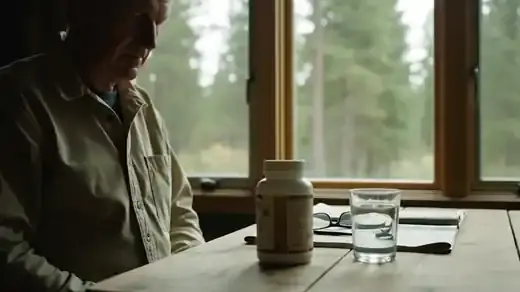
Wallace Thorn is the pen name of this desk.
Everything on this page about the bottle comes from the maker's own listing, the photographs of its official panels, and its published terms, all read on September 20, 2026.
There is a shelf of mushroom bottles at the co-op here that did not exist five years ago.
Eleven bottles at last count, all of them brown and cream, all of them promising a quiet morning.
A neighbor stopped me next to it in August with a bottle in each hand and one question.
He wanted to know whether there was anything on either label he could actually check.
That is the best question anybody has asked me about that shelf.
Most of what is printed on a mushroom bottle cannot be checked by you or by me.
The name of the mushroom, the word "premium", the drawing of a forest, the word "potency": none of those has a number you can hold to account.
One line on one of those two bottles could be checked, and it took me about four seconds and a division to do it.
It is the line that names how much of the extract is beta-glucan, and the bottle that carried it was Real Mushrooms' Organic Lion's Mane Extract Capsules.
Two capsules carry 1,000 milligrams of lion's mane extract, and the panel says 300 of those milligrams are beta-glucans.
Three hundred over a thousand is thirty percent, and thirty percent is exactly what the front of the label says.
That is the whole reason this page exists, and I want to be honest about how small a thing it is before I spend eight thousand words on it.
A printed figure that matches its own arithmetic is not a result, not a benefit and not a reason on its own to buy anything.
It is a statement about material rather than about you.
It says something about what is in the capsule, and nothing at all about what happens after you swallow it.
But it is checkable, and almost nothing else on that shelf is.
On a shelf built out of adjectives, a number that survives division is worth an afternoon.
So here is the afternoon.
The mushroom, the extract, the figure, the arithmetic of the bottle, the trials that exist, the distance between them and this dose, the five sentences on the front of the label read one at a time, the return terms, the reviews, and the cheaper things to rule out before any of it.
Three Hundred Milligrams Out of a Thousand, and What That Fraction Is
Start with the panel itself, because everything on this page hangs off four printed lines.
The serving size is two capsules, and the bottle of 120 holds sixty of them.
The label direction is one line long: adults take two capsules per day.
The first active line reads organic lion's mane mushroom extract, fruiting body, hot-water extracted, 1,000 milligrams.
The second line is indented under it and reads: of which beta-(1,3)(1,6)-glucans, 300 milligrams.
That indentation matters more than it looks.
It means the 300 is not an extra ingredient stacked on top of the 1,000; it is a declared fraction of the same gram.
Divide 300 by 1,000 and you get 0.3.
Thirty percent, which is what the maker's listing claims on the front: more than thirty percent beta-glucans.
The claim on the front and the figures on the back agree with each other. That is rarer on this shelf than you would think, and it is the smallest possible compliment I can pay a label.
I make a habit of checking that kind of thing because the failure is common and nobody ever mentions it.
A front panel says one thing, a back panel implies another, and the two are separated by three inches of plastic and nobody in the aisle does the arithmetic.
Here the arithmetic closes.
I checked it standing in the aisle with my reading glasses on, and it took less time than reading the marketing paragraph underneath it.
What a Beta-Glucan Is, in Plain English
A beta-glucan is not a vitamin, and it is not an active compound in the way that phrase is usually used.
It is a long chain of sugar molecules, and it is most of what a mushroom's cell wall is built out of.
Think of the mushroom as a structure made of tiny tubes.
The walls of those tubes are mostly beta-glucan, which is why beta-glucan is the thing you measure when you want to know how much mushroom is in a jar of powder.
That is the whole point of the measurement, and it is worth saying slowly.
Beta-glucan is measured as a test of identity, not as a test of benefit.
If you hand a laboratory a scoop of pale powder and ask it whether that powder is mushroom, the beta-glucan content is one of the answers it can give you.
A high figure says the powder is largely mushroom tissue; a low figure says a good deal of it is something else.
What a beta-glucan figure cannot tell you is whether anything will be different on a Tuesday in November.
There is no trial of beta-glucans on memory or attention in healthy adults that I could register, and I looked for one before I wrote a word of this.
So we are dealing with a quality number and not an outcome number.
I will keep saying that, because the distance between those two things is where most of the money on that shelf gets made.
Why Most Mushroom Bottles Print No Figure at All
Here is the part of the shelf nobody explains in the aisle.
A mushroom has two halves to its life.
There is the part you would recognize as a mushroom, the cap and the flesh above ground, which the trade calls the fruiting body; and there is the fine white web that lives in the wood or the soil, which is called mycelium.
Growing a fruiting body takes months, space and skill.
Growing mycelium takes a tray of sterilized grain, a warm room and a few weeks, and when it is done the grain and the web have grown into each other and cannot be separated.
So a jar can be honestly labeled "lion's mane" and be mostly rice or oats by weight.
Not by fraud: by the ordinary practice of a whole branch of the industry, which grinds the grain and the mycelium together because there is no way to take them apart.
Now you can see why a beta-glucan figure is inconvenient.
Grain carries very little beta-glucan, so a product grown on grain will test low, and a number that tests low is a number you do not print.
A label with no beta-glucan figure is not automatically a bad label. But a label that prints one has put a checkable number on the shelf, and a label that prints none has not.
This particular bottle takes the argument head on.
Its front panel reads, in capitals, no grain, no starch, no fillers, and the listing says no added starch, mycelium or grain of any kind.
Those are strong words and they are the maker's, not mine.
What I can say is that a company willing to print a 30 percent figure is making a statement that a laboratory could contradict, which is more than the neighboring bottles are doing.
More Than Thirty Percent: The One Sentence You Can Check With Division
The front of this label carries five short statements, and I will read them all later, one at a time.
The one that concerns this section is the beta-glucan sentence, because it is the only sentence on the shelf with a testable number in it.
The listing states more than thirty percent beta-glucans.
The back panel states 300 milligrams of beta-glucans inside 1,000 milligrams of extract.
Those two are the same claim written twice, once as a percentage and once as a weight.
When a front panel and a back panel say the same thing in two different units, that is a small piece of evidence that somebody in the company is paying attention.
Now the caution, and it is the important half of this section.
A number printed by a company is a claim by that company, not an independent audit.
The label also carries the phrase "scientifically verified for active compounds", which is a statement about laboratory testing of material.
It is not a result in people, it does not name the laboratory on the bottle, and it is not the same thing as somebody outside the company checking the jar you were sold.
If the figure matters to you, there is a sentence you can send in an email, and it costs nothing.
Ask the seller which laboratory measures the beta-glucan content, by which method, and whether a certificate of analysis is available for the lot number on your bottle.
You will learn two things from the reply.
You will learn the answer, and you will learn how a company behaves when a customer asks a specific question.
The Word "Extract", and the Ratio the Canadian Label Prints
Here is the line that changed how I read this bottle, and it is not on the American label at all.
The same product is sold in Canada, and Canadian rules ask for more detail on a mushroom extract.
The Canadian panel prints, per capsule, extract 1:1, 500 milligrams dry.
Read that slowly, because it is doing real work.
A 1:1 extract means the finished extract weighs the same as the dried mushroom it was made from.
So 500 milligrams of this extract came from 500 milligrams of dried mushroom, and a full serving of two capsules came from a gram of it.
That is not a concentrate. It is a gram of dried mushroom, put through hot water and dried again.
The word "extract" makes most people picture something condensed, five or ten times stronger than the plant. On this label the ratio is one to one, and the maker prints it where the law asks for it.
I do not say that as a complaint.
It is arguably the most useful single number on either panel, because it lets you translate the marketing word into an ordinary kitchen quantity.
What it means in practice is that a serving of two capsules is about a gram of lion's mane in the same sense the trials mean a gram.
That makes the comparison with the trials honest rather than guesswork, which is not something you can do with most of the bottles beside it.
It also means nobody should be impressed by the word "extract" on any label until they know the ratio.
On this one it is printed, in Canada, in small type, and that is where I found it.
Hot Water, the Fruiting Body, and What Gets Left Behind
The panel says hot-water extracted, fruiting body only, and both halves of that phrase mean something.
Hot water is the old method, and it is the method behind the food.
Dried mushroom is simmered, the liquid is separated from the spent solids, and the liquid is dried back down to a powder.
It is what happens in a pot of mushroom broth, industrialized and then dried.
The things that dissolve in hot water come along, and the things that do not are left behind in the pot.
Beta-glucans are among the things hot water pulls out of a mushroom wall, which is part of why this method and this measurement go together.
Other constituents are pulled out better by alcohol, and this product does not use alcohol at all.
That has a practical consequence worth knowing for a man over sixty.
There is no alcohol in the capsule and no carrier of any kind: the panel lists the extract, the capsule shell, a flow agent and an anti-caking agent, and nothing else.
The second half of the phrase, fruiting body only, is the claim from the section above written in technical language.
It says the powder came from the mushroom above ground and not from a grain tray.
Is the hot-water method better than the alternatives?
For this question I have nothing to hand you: no study on this page compared one extraction method against another in people, and I am not going to pretend otherwise.

The Word "Organic" on This Panel, and What It Certifies
There is a green and white seal on the front of this bottle and a certifier's name beside it, and the seal is worth one section because almost everybody misreads it.
Organic certification is a statement about farming and handling.
It says the substrate, the growing and the processing were audited against a published standard and that certain inputs were not used.
It is not a statement about strength, about beta-glucan content, or about whether anything works.
A certified-organic product can be weak, and an uncertified one can be strong: the seal is about method, not about potency.
That is why the beta-glucan figure and the organic seal do two different jobs on the same label.
The seal speaks to how the mushroom was grown; the figure speaks to how much mushroom ended up in the jar.
Two independent statements, about two different stages, neither of which is a result. Read together they tell you a fair amount about the manufacturing and nothing about your afternoon.
The seal does carry one practical advantage, and it is the audit trail behind it.
A certifier keeps records, which is part of why a company operating inside that system can answer a question about a lot number at all.
I would not pay a premium for the seal on its own.
I would read it, like the printed figure and the published address, as one more thing the company has agreed to be checked on.
A Gram a Day Against the 3.2 Grams of the Twelve-Week Trial
Now the comparison everybody wants and almost no advertisement makes.
The study that put this mushroom on the American shelf ran for twelve weeks in Japan.
Thirty-one healthy adults over fifty took a lion's mane fruiting-body preparation every day, and the group taking it scored higher on a standard mental-status test than the group taking a dummy. [1]
The daily amount in that trial was 3.2 grams.
The daily amount in this bottle is one gram.
A little under a third of the trial's dose, in two capsules, every morning.
To reach the trial's amount out of this bottle you would take between six and seven capsules a day.
At that rate the 120-capsule bottle empties in under nineteen days, and the cost of a day goes from about fifty-eight cents to roughly a dollar eighty-six.
I am not telling you to take six capsules a day.
The label says two, the maker is the party responsible for its own directions, and a page like this one has no business inventing a dose.
I am telling you what the gap is, in capsules and in dollars, because the gap is the single most useful fact on this page.
Every bottle on that shelf sits at some distance from the trial it quietly leans on, and almost none of them will tell you how far.
There is a second honest caution about that trial, and the maker does not owe it to you but I do.
The same twelve weeks that produced a higher score on the mental-status test produced no change at all on a test of visual retention, which is exactly the kind of mixed result an advertisement never mentions. [1]
Thirty-one people is a small trial.
It ran in one country, for three months, in adults whose diet and daily life are not yours, and it has not been repeated at scale.
One gram a day against 3.2 grams a day, from a twelve-week trial in 31 people with one positive result and one flat one. That is the whole evidential position, stated as plainly as I can state it.
The Second Study: One Dose of 1.8 Grams, and Forty-One Adults Under Forty-Five
There is one more trial worth putting on the table, and it points in a useful direction even though it is not about men our age.
Forty-one healthy adults aged eighteen to forty-five took a single 1.8-gram dose of lion's mane.
An hour later they performed faster on a task that measures how well you hold your attention while something tries to pull it away. [2]
The same study also ran for twenty-eight days.
Over those four weeks it produced only a non-significant trend on a self-rated measure, which in plain English means the longer arm of the study did not land. [2]
So the evidence for this mushroom is one small positive over twelve weeks at 3.2 grams a day in older adults, and one short-term result at 1.8 grams in young adults.
Between them sits a gram a day in a bottle that costs thirty-five dollars.
I put the ages in bold type on purpose.
A result in adults under forty-five is not a result in a man of sixty-eight, and anybody who quotes it at you without the age has left out the part that matters.
This is also where I want to say something about the word "emerging".
The maker's own page says the mushroom is backed by traditional use and emerging research, which is a modest and accurate phrase.
It does not say settled, it does not say clinical, and it does not attach a promise to the bottle.
That restraint is worth noticing on a shelf where restraint is scarce.
What a Printed Figure Is, and What It Is Not
We are halfway, so here is the argument of this page in one place.
The figure on this label is a good thing and a small thing at the same time.
It is good because it is checkable, it is specific, and it exposes the company to being contradicted.
It is small because no trial of beta-glucans on memory or attention exists to attach to it.
The beta-glucan content tells you what is in the jar; the trials tell you what happened to some people at a dose three times larger.
A number you can check is worth more than an adjective you cannot. It is still not the same thing as a result.
If a salesperson ever tells you that thirty percent beta-glucans is why a product works, that person has crossed the line between the two kinds of number.
Nothing on the label makes that claim, and neither does the company as far as I can find.
The best thing I can say about this figure is procedural rather than biological.
It tells you that somebody weighed something, wrote the answer down, and was willing to have it printed where a competitor could check it.
That is not nothing on a shelf built out of forests and adjectives.
It is also not a reason on its own to take the bottle home, and this page will not pretend it is.
Sixty Mornings in a Bottle, and What a Morning Costs
Arithmetic again, because the arithmetic is what decides whether a bottle is a test or a subscription.
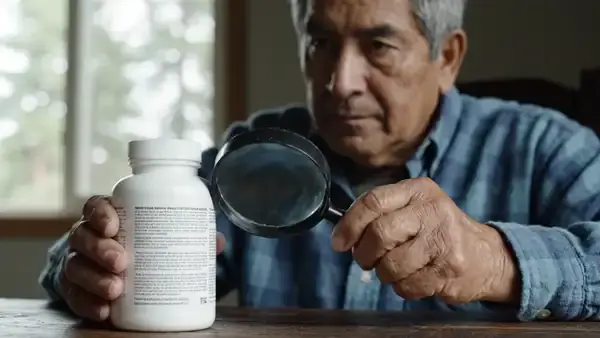
This is the point to put the bottle itself on the table, since every number in this section starts from what is inside it.
One hundred and twenty capsules go in the bottle.
Two capsules make a serving and the direction is one serving a day, so the bottle is sixty mornings.
The price on the maker's own page when I read it was $34.95.
Divide that by sixty and a morning costs about fifty-eight cents.
There is a larger bottle of 300 capsules at $69.95, which the listing marks as a bonus size.
That works out to a hundred and fifty mornings at about forty-seven cents each.
Sixty mornings for thirty-five dollars, or a hundred and fifty for seventy. Check both numbers on the day you look, because the price is the seller's to change and this page prints no price you should rely on.
I would buy the small bottle first, and I would buy it for a reason that has nothing to do with saving money.
Sixty mornings is long enough to be a fair test and short enough that you are not committed to something you have not tried.
A hundred and fifty mornings of anything is a decision you should make after the first sixty, not before them.
The bonus size is a better price per capsule and a worse first purchase, and those two things are both true at once.
Shipping is worth one line.
The seller sends orders at no charge above seventy-five dollars and charges a few dollars below that line, so a single bottle sits under it.
The Other Three Lines on the Panel
Most labels have a short list at the bottom that nobody reads, and on this one it is three items long.
The first is hypromellose, which is the capsule itself.
It is made from plant fiber rather than gelatin, which is why the bottle suits people who avoid animal products.
The second is microcrystalline cellulose, listed as a flow agent.
It is refined plant fiber, and its job is to keep the powder moving evenly through a filling machine so that every capsule holds the same amount.
The third is silicon dioxide.
It is a fine mineral powder that keeps the mix from clumping in a humid room, and it appears in a very large share of the capsules sold in America.
None of those three does anything for you, and none of them is meant to.
They are manufacturing, and the honest reason to read them is that their absence or presence tells you how plain a product is.
A three-line other-ingredients list is short.
I have read bottles this year with nine lines under that heading, and every extra line is one more thing to look up.
There is no sugar, no sweetener, no flavor, no color and no alcohol in this bottle.
There is also no caffeine, which matters if you already take your morning with coffee and would rather not stack anything on top of it.
The Front of the Label, Read One Sentence at a Time
Here are the five short statements on the front of this bottle and the listing, each with what I can and cannot say about it.
The first is that the extract is hot-water extracted from one hundred percent lion's mane, fruiting bodies only, for potency.
The first half is a description of a method and a part of the mushroom, and I have no way to audit it from here; the last two words are marketing, because "potency" has no defined meaning on a supplement label.
The second is no grain, no starch, no fillers.
It is a meaningful claim precisely because it is falsifiable: a laboratory can test a jar for starch, and the company has volunteered a statement it could be caught on.
The third is more than thirty percent beta-glucans, and we have now spent half this page on it.
It agrees with the back panel, it is checkable by division, and it is a measure of material rather than of benefit.
The fourth is scientifically verified for active compounds.
That is a statement about laboratory testing, not a result in people, and the bottle does not name the laboratory or the method.
The fifth is the mildest and the one I would leave standing.
The listing says lion's mane can help you remain mentally agile, which is the ordinary language of a supplement label: a general statement about everyday function, carefully hedged, with the standard sentence about the Food and Drug Administration underneath it.*
Four descriptions and one hedge. No named condition, no promise of a result, and no picture of anybody's transformation on the package.
For a category that produces some of the loudest advertising in the country, that front panel is unusually quiet.
There is one more thing the listing does that this page will not follow it into.
It names two other areas of the body besides mental function, and since this page is about memory and everyday focus only, I have left them where I found them.
What This Label Does Not Print, and Why I Asked Anyway
A fair reading names the gaps as well as the figures, and this panel has four.
It does not print where the mushrooms were grown.
The company is Canadian and the warehouse is American, and neither of those is the same as the farm.
It does not print a harvest or production date, only a best-before date.
That is ordinary and legal, and it still means you cannot tell a fresh lot from a lot that sat in a warehouse for a year.
It does not name the laboratory behind the phrase about verified active compounds, and it does not print a lot certificate on the bottle.
Very few labels do; the question is whether the company will send one when you ask.
And it does not print a strain, which is the mushroom equivalent of a grape variety.
Nobody on this shelf prints one, so it is a gap in the whole category rather than a failing of this bottle.
None of those four gaps is a scandal.
I list them because the entire argument of this page is that a printed number is worth something, and the same logic obliges me to say which numbers are absent.
Two Capsules, and the Small Business of Taking Them
A practical section, because the best label in the world is useless if the routine falls apart in week three.
The direction is two capsules a day, and the label does not tie them to a meal.
That leaves the timing to you, which is a small freedom and a small trap.
I would take both at breakfast, together, every day.
Breakfast is the most fixed point in most retired mornings, and a fixed point is the only reason a two-month habit survives.
Splitting them, one in the morning and one at midday, is equally consistent with the label.
It is also the arrangement most likely to end with a capsule forgotten in a shirt pocket, which turns sixty mornings into fifty-one and ruins the arithmetic of your own test.
The capsules are an ordinary size and the shell is plant fiber, which dissolves readily with water.
The label asks you to keep the bottle closed in a cool, dry place, which in most houses means a cupboard and not a windowsill.
If swallowing capsules is genuinely difficult, this is the wrong format and there is no way around it.
The same company sells the same extract as a loose powder for exactly that reason, and that is a question for the seller rather than for this page.
One last practical note that costs nothing.
Put the bottle where the coffee is, because the thing you already do every morning is the only reliable place to hang the thing you are trying to start.
One Page Says a Hundred Days, Another Says Thirty and Unopened
Now the part that would actually cost you money, and it is the weakest thing I found.
The seller's satisfaction page offers a hundred-day satisfaction promise.
It covers one opened product per customer, and it applies only to orders placed on the seller's own site.
The seller's returns page says something different.
It describes a thirty-day window and accepts unopened product only, with a prepaid label inside the first thirty days and the cost falling on you from day thirty-one to day sixty.
Both pages are live, both are the seller's own, and neither one mentions the other.
I do not think it is a trap, and I do think it is unfinished housekeeping on a website.
Write one email before you order. Ask which of the two pages governs an opened bottle bought directly from the seller, and keep the reply.
That email is worth sending for a second reason.
You will have the answer in writing before you have spent anything, and a company's reply to a plain question is itself information.
Note also what neither page covers.
Both are written for purchases from the seller, so a bottle bought through a large marketplace is governed by that marketplace's terms and not by either of these.
Three Questions Worth a Toll-Free Call
The seller answers a toll-free line, which is unusual enough on this shelf that it ought to be used.
The first question is the one this whole page turns on.
Which laboratory measures the beta-glucan content, by which method, and can you have the certificate for the lot number printed on the bottle you would be sent?
The second is about the two pages that disagree.
Does the hundred-day satisfaction promise or the thirty-day unopened returns page govern an opened bottle bought directly from the seller, and can you have that in writing?
The third is about the grower.
Where are the mushrooms for this lot grown, and is the same farm used for every lot?
Three questions, one telephone call, and nothing bought yet.
What you do with the answers is up to you, but the behavior of the company while answering is itself a fact worth collecting.
A company that answers all three plainly has told you something that no front panel can.
Calgary on the Label, Sparks on the Parcel
Two addresses belong to this bottle and they are in two different countries.
The company is Real Mushrooms Inc., registered in Calgary, Alberta, and that is the address printed on the label.
United States orders ship from a warehouse in Sparks, Nevada, which is why the parcel on your porch has an American postmark.
The seller publishes an email address and a toll-free telephone number, and both are on this page's contact link.
Shipping is inside the United States, and the extract itself is certified organic by a third-party certifier.
None of that is a claim about the mushroom.
It is a claim about who you would be dealing with, and I keep those two categories apart on every page I write.
A company can be reachable, honest about where it sits and precise on its panel, and still be selling you a third of the dose of the only twelve-week trial in people your age.
Both halves of that sentence are true here, and you should weigh them separately.
Eleven Hundred Reviews, the Ten Most Recent, and the Six I Kept
The seller's review widget carried 1,145 reviews when I read it, which is a large number and a difficult one.
Nobody can read eleven hundred reviews and nobody should pretend to.
I read the ten most recent, which is the page any customer sees first, and I kept the six that said something about this product and nothing about a medical condition.
Four of the ten I set aside, and I will tell you why so you can weigh what is left.
One described a condition, one was about a different product in the same range, and two were star ratings with no words in them at all.
There is a disclosure that belongs beside all of this, and it comes from the seller's own listing for a neighboring product.
A customer there stated that the seller had offered a ten-dollar store credit for writing a review, which is a normal practice and one you are entitled to know about before you read anything below.
A store credit does not make a review false.
It does make the set of reviews on any listing lean gently toward the people who felt like writing one, and that is worth holding in mind on any shelf.
The portraits beside these reviews are illustrations, not the reviewers.
The words are theirs, quoted as the seller published them, and the star ratings are the ones the widget shows.

I researched many products and Real Mushrooms' Lions Main was the best available on the market. Thanks

I've been taking lions mane for over 5 years & swear I saw a difference in my ability to speak better within 3 months. I'm sharper than before I took them. I have brought them at least 30 customers.

Been using Lion's Mane and 5 Defenders mushroom products for many months and trust their purity. I approve of products grown and marketed by Canadian companies as Real Mushrooms are, and believe consistent use over time is beneficial.

It got here to my place less than a week. It's too early to tell any different but I'll keep you posted. I have taken the lion mane Mushroom before not this brand in particular, but other brands and I have confidence in this one.

I love, love, this product. It makes me feel energized, sharp and ready for life! I have let many People Know about it!
Read those the way I do, which is as five ordinary opinions and nothing more.
Not one of them is evidence about you, and the most useful of the five is the four-star one, because it says the honest thing: it is too early to tell.
That is the correct posture for a bottle of sixty mornings, and it is the posture this page recommends.
The people who write reviews in the first week are describing a delivery, not a result.
Six Things a Printed Number Will Not Buy You
I put the list here because it is the part of a page like this that usually gets left out.
- They will not make you remember a name you were going to forget.
- They will not deliver the dose used in the twelve-week trial in adults over fifty; they deliver a little under a third of it.
- They will not offset a short night, a skipped breakfast or a week of poor sleep.
- They will not do anything measurable because of the beta-glucan figure, which is a measure of material and not a result.
- They will not replace anything a clinician gave you, and they are not a reason to postpone an appointment.
- They will not tell you anything at all if you take them without writing down what you noticed.
I write some version of that list on every page, and I mean it more on the ones with a good label than the ones with a bad one.
A well-made bottle invites you to expect more of it, and the expectations are the part that has to stay honest.

What to Rule Out Before You Spend Thirty-Five Dollars
If your afternoons have been foggier this year, four ordinary things are more likely than a missing mushroom, and every one of them is cheaper.
The first is water.
In a study of 1,111 adults aged sixty to eighty-nine, a third of them were measurably short of water, and that group slipped faster on a test of processing speed than the rest. [3]
A review of eighteen studies covering more than thirty-three thousand older adults reached the same conclusion with the same caution.
The link to poorer thinking scores is there but the evidence behind it is sparse, and none of it tests a product. [4]
The second is the hour of the day.
Most people over sixty have a window in the morning when everything is easier, and most people spend that window on email and then take their hardest task into the afternoon.
The third is hearing.
Straining to follow a conversation in a room with a fan running looks exactly like failing to remember it, and a hearing check costs a morning.
The fourth is the shape of what you eat over years rather than what you ate this week.
In a three-year randomized trial of 604 older adults, a Mediterranean-style eating pattern and a control diet with mild calorie restriction both improved thinking scores, and neither pulled ahead of the other. [5]
Read that last one carefully, because it cuts both ways.
Both groups improved, which is encouraging; neither beat the other, which means the specific pattern mattered less than the fact that both groups were eating deliberately.
Water, the hour you do your hardest work, your hearing, and the shape of a year's meals. Four things that cost nothing and are more likely than anything on that shelf.
One more line about coffee, since it comes up every time.
The Food and Drug Administration puts four hundred milligrams a day, roughly two to three twelve-ounce cups, in the range not generally associated with problems in most healthy adults, and it advises a conversation with your own provider if you take anything daily. [6]
The capsules in this bottle carry no caffeine at all.
They neither add to your cup nor replace it, which is one fewer thing to balance in a morning.
The Sixty-Morning Test: One Bottle, One Line a Day
If you do buy a bottle, here is how to get information out of it instead of a feeling.
Buy one bottle of 120 and nothing else.
Write the date you open it on the lid in pen, and write the date sixty days later beside it.
Take the two capsules at the same point in the morning every day.
With breakfast is easiest, because breakfast is a fixed point and a fixed point is what makes a habit survive week three.
Change nothing else for those sixty days.
Not your coffee, not your bedtime, not a second bottle from the same shelf, because two changes at once produce an answer you cannot read.
Keep a notebook by the kettle and write one line a day.
Not a paragraph: one line, about the afternoon, in the same handwriting, before you go to bed.
Sixty lines in one notebook will tell you more than eleven hundred reviews.
At the end of the sixty days read the first ten lines and the last ten lines, in that order, and then decide.
That comparison is the whole experiment, and it is the only part of this page you cannot buy.
And if the sixty lines say nothing happened, that is an answer too, and a good one.
It cost you thirty-five dollars and two months to learn something specific about your own mornings, which is cheaper than three years of buying bottles on a hunch.

Who This Bottle Is For, and Who Should Leave It There
I will put this as plainly as I can, because most pages like this one never say who should walk away.
It suits a man who would rather take one ingredient he can name than eight he cannot.
It suits somebody who wants a checkable figure on the label and is willing to accept that the figure is about material, not about results.
It suits a person who will take one bottle as a sixty-day test with a date on the lid and a notebook by the kettle.
And it suits somebody who understands that a gram a day is a little under a third of the only twelve-week trial in adults over fifty. [1]
It does not suit anybody who wants a number on a panel to stand in for a result.
No number on any panel does that, and this one does not claim to.
It does not suit a person who is allergic to mushrooms, and it is not for anyone who would take it instead of asking a clinician about a change they have actually noticed.
If you take anything daily, ask your pharmacist before this bottle, the way you would before anything else.
And it does not suit somebody looking for the trial's dose in a convenient package.
That would be six to seven capsules a day, the bottle would last under nineteen days, and this page is not recommending it.
Every line printed on this panel, what each one is, and what the cited research does and does not say about it, is written out in full in the ingredient guide linked at the foot of this page.
That guide also carries the cautions, the complete reference list, and the disclosures this page is required to make.
Sixty mornings from a single mushroom
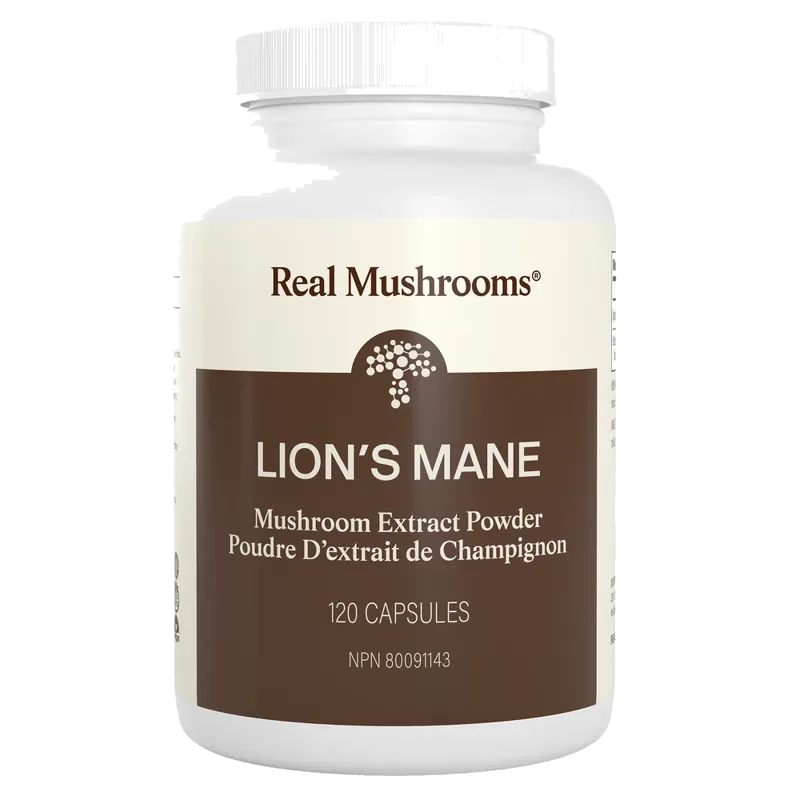
A gram a day of hot-water lion's mane extract in two capsules, with the beta-glucan content printed on the label.
SEE THE 120-CAPSULE BOTTLESold by Real Mushrooms Inc., Calgary, and shipped inside the United States from Sparks, Nevada · 120 capsules · 60 servings of two · one serving a day · a hundred-day satisfaction promise on one opened product on the seller's own site, and a stricter unopened-only returns page: ask which applies before you order
What people ask about this bottle
Is this medicine?
No. It is a dietary supplement: one mushroom extract in a plant-fiber capsule, made for a company in Calgary.
How long does one bottle last?
Sixty mornings. One hundred and twenty capsules, two a day, which is the label's own direction.
What does the 300 milligrams of beta-glucans mean?
It means 30 percent of the gram of extract is mushroom cell-wall fiber, which is how makers show the powder is mushroom rather than grain. It is a measure of material, not a benefit: I could register no trial of beta-glucans on memory or attention in healthy adults.
How does a gram a day compare with the study?
The twelve-week trial in 31 adults over fifty used 3.2 grams a day, so this is a little under a third of it. [1]
Does "extract" mean it is concentrated?
Not here. The Canadian panel prints a 1:1 ratio, 500 milligrams dry per capsule, so a gram of capsules came from a gram of dried mushroom.
Should I ask anyone before I take it?
Yes, if you take anything daily, and avoid it entirely if you are allergic to mushrooms. Your pharmacist can answer both in five minutes.
What if I open it and don't get on with it?
That is exactly what the seller's two pages disagree about. Ask by email which one governs an opened bottle bought directly from them, and keep the reply.
How much does it cost?
This page prints no price you should rely on, because the seller sets it and changes it. It was $34.95 for 120 capsules on the day I read the listing, about fifty-eight cents a morning.
Three Hundred, One Thousand and Three Point Two, in Sixty Seconds
- A white bottle of 120 vegetable capsules from Real Mushrooms Inc. of Calgary, shipped to United States addresses from Sparks, Nevada; two capsules are a serving and the bottle holds sixty.
- One serving carries 1,000 milligrams of hot-water lion's mane extract, fruiting body only, and the panel names 300 of those milligrams as beta-(1,3)(1,6)-glucans.
- Three hundred over a thousand is thirty percent, which is exactly what the front of the label states: the two panels agree with each other, which most of this shelf does not manage.
- The beta-glucan figure is a measure of how much of the powder is mushroom rather than grain; no trial of beta-glucans on memory or attention in healthy adults is registered on this page.
- The Canadian panel prints a 1:1 ratio, 500 milligrams dry per capsule, so the word "extract" here means a gram of dried mushroom rather than a concentrate.
- A gram a day is a little under a third of the 3.2 grams a day used for twelve weeks by 31 adults over fifty, where one test improved and a second test did not move. [1]
- A single 1.8-gram dose was followed an hour later by a faster attention result in 41 adults aged 18 to 45, and the same study's four-week arm did not land. [2]
- Other ingredients are three lines long: the plant-fiber capsule, a flow agent and an anti-caking agent. No sugar, no flavor, no alcohol and no caffeine.
- The satisfaction page offers a hundred days on one opened product bought from the seller; the returns page says thirty days and unopened only. Ask in writing which governs before you order.
- It was $34.95 for sixty mornings on the day I read the listing, about fifty-eight cents a morning, with shipping at no charge above a seventy-five dollar order.
- Eleven hundred and forty-five reviews on the seller's widget; I read the ten most recent and kept six, with the seller's ten-dollar review credit declared beside them.
- Before any of it: water, [3] [4] the hour you do your hardest work, your hearing, and the shape of a year of meals. [5]
What One Checkable Number Is Worth on That Shelf
Here is the whole page in one breath.
This is the plainest bottle on a shelf that specializes in complication: one mushroom, one gram, three other ingredients and a figure that survives division.
Everything I checked on the panel closed, and the one thing that did not close was on the seller's website rather than on the bottle.
Against that stands the distance from the only twelve-week trial in people your age, which is a factor of three and which no amount of good labeling closes.
A careful label and a small dose are not opposites; they are simply two different facts, and this bottle has one of each.
If you want a single ingredient you can name, a number you can check, and sixty mornings to find out whether anything changes, this is a defensible thirty-five dollars.
If you want the dose of the study, this bottle is not it, and I would rather tell you that here than let you find out in nineteen days.
Buy one bottle of 120, write the date on the lid, take two at breakfast, change nothing else, and write one line a night. Read the first ten lines against the last ten, and then decide for yourself.
One hundred and twenty capsules, and where the figure is printed
A gram a day of hot-water lion's mane extract in two capsules, with the beta-glucan content printed on the label.
SEE THE 120-CAPSULE BOTTLEReal Mushrooms Inc., Calgary · 120 capsules, 60 servings · 1,000 mg of hot-water extract per serving, of which 300 mg beta-glucans · shipping at no charge above the seller's order line; a single bottle sits below it
P.S. If you take one thing away from this page, take the difference between two kinds of number.
Three hundred milligrams of beta-glucans is a number about the powder in the jar.
Three point two grams a day for twelve weeks is a number about people, and this bottle delivers a little under a third of it. [1]
P.P.S. If the fog has been with you for a year, and it is there in the morning before anything else, that is a conversation with your own clinician and not a shelf.
No bottle of any kind answers in sixty mornings what a proper appointment answers in twenty minutes.